

Quick answer
Pack for four climate zones in one bag: sub-zero nights near the Salkantay Pass and humid, mosquito-heavy heat in the Santa Teresa valley. Split gear between a porter-carried duffel and a daypack you never hand over — that daypack holds water, rain shell, sun protection, snacks and the 20 PEN community entrance fee in small notes, since the Mollepata checkpoint takes cash only.
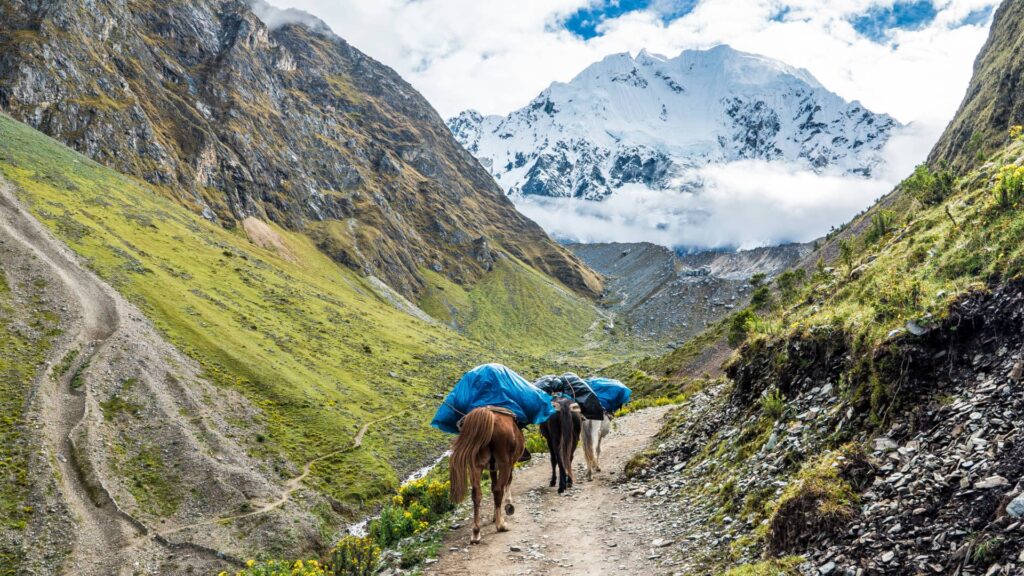
The Salkantay route climbs to roughly 4,630 metres at the Abra Salkantay, then drops close to 2,000 metres in a single afternoon — a descent steep enough that most trekkers change their entire clothing system twice in one day. That vertical spread is the reason a salkantay trek 5 day packing list looks nothing like a checklist for a flat multi-day walk. It is not a question of how much to bring, but of how the load is divided. Almost every trekker on this trail operates two bags. A duffel travels ahead by mule or horse to the next camp and carries sleeping gear, spare layers and toiletries. A daypack stays on the shoulders through Soraypampa, Humantay Lake, the pass itself, and the long descent toward Chaullay and the Santa Teresa valley. Anything needed between breakfast and dinner belongs in the second bag, because the first one is unreachable for eight to ten hours at a stretch. Operators impose a weight ceiling on the duffel, typically enforced at the Mollepata staging point, so a good Peruvian Andes trekking packing strategy front-loads decisions before departure rather than at the trailhead. The altitude gradient does the rest of the work. Nights at Soraypampa sit near freezing; by day four the cloud forest around the hot springs and the coffee plantations near Lucmabamba is warm, wet, and full of insects. A single set of clothing cannot cover both, which is why layering — rather than bulk — governs a sensible salkantay trek 5 day packing list. Sun exposure at altitude is fierce even under cloud, and the ultraviolet load near the glacier is far higher than most visitors expect from a mountain that looks cold. Two practical notes carry across every category. Cash matters: the community entrance fee for the Mollepata region and Humantay Lake access is settled in soles at the checkpoint, and small denominations save time. And departures begin early — the recommended arrival window is 05:00–08:00, which means gear is packed in the dark by headlamp on most mornings. Trekkers who lay out the following day's clothing the night before move faster and lose fewer items to camp floors. The dedicated checklist, itinerary and access sections on this site break down the specifics; what matters here is the principle that shapes them all.
“It is not a question of how much to bring, but of how the load is divided.”
Essential Gear for Your Salkantay Trek 5 Day Packing List
Work through this gear checklist in order, starting weeks out and finishing the morning you set off.
-
Break in your hiking boots — Waterproof mid-cut boots need weeks of wear to avoid blisters over 5 days.
-
Source a -5°C sleeping bag — Nights near Salkantay pass drop below freezing, and rented bags vary in rating.
-
Pack layers, not bulk — A base layer, fleece, and waterproof shell handle the swing from 4,600 m to cloud forest.
-
Confirm your duffel weight limit — Porters and horses carry a capped duffel, so weigh it before departure and keep the rest in a daypack.
-
Carry your original passport — The same document used for booking is checked along the trail and at Machu Picchu.
-
Bring 20 PEN in small notes — The community entrance fee for the Mollepata region and Humantay Lake access is paid in cash.
-
Prepare 3 litres of water capacity — Bladders plus purification tablets cover the long stretches between refill points.
-
Set out gear the night before — An 05:00–08:00 start leaves no time to hunt for a headtorch or gloves.
Daily Terrain Impacts on Your Salkantay Trek 5 Day Packing List
This day-by-day route overview suits first-time trekkers deciding what to carry, covering the full five-day crossing from high Andean grassland at Mollepata to cloud forest above Aguas Calientes. Total walking distance runs roughly 70 km across terrain that shifts from glacial moraine to humid jungle within 48 hours.
Mollepata to Soraypampa
Transfer from Cusco, then a 3-4 hour walk through dry farmland to camp at 3,900 m, with an optional afternoon climb to Humantay Lake. Starting between 05:00 and 08:00 gets you to camp before afternoon cloud closes in.
Salkantay Pass crossing
The longest day: 7-9 hours over the 4,630 m pass beneath Nevado Salkantay, then a steep drop to Chaullay or Collpapampa. Sub-zero dawn temperatures give way to warm rain within a few hours of descending.
Cloud forest to Lucmabamba
A 5-6 hour descent along the Santa Teresa river valley through coffee and granadilla plantations at around 2,000 m. Humidity rises sharply here and nothing left damp overnight will dry.
Llactapata ridge to Hidroelectrica
A 3-hour climb to the Llactapata ruins for the side-on view of Machu Picchu, then descent to Hidroelectrica and the flat rail-line walk to Aguas Calientes.
Machu Picchu citadel
Early ascent to the citadel by bus or the stairs from Aguas Calientes, followed by a guided circuit of roughly two hours. Day packs only are permitted inside; larger bags go in storage at the entrance.
Seasonal Weather Factors for Your Salkantay Trek 5 Day Packing List
The dry season, spanning from May to September, offers the most stable conditions for the Salkantay Trek. During this window, clearer skies and reduced precipitation make navigation easier and improve visibility across the high-altitude passes.
Dry Season (May–September)
Low to moderateDry, clear skies; 5°C to 20°C
Expect cold nights and sunny, temperate days that require versatile layering.
Wet Season (October–April)
Moderate to highFrequent rain; 8°C to 22°C
Higher humidity necessitates waterproof outer layers and moisture-wicking materials.
Early Morning (05:00–08:00)
Low—
Starting within the best arrival window ensures cooler temperatures and cloud-free mountain views.
Verdict: The best time for the trek is during the dry months of May through September, prioritizing a start time between 05:00 and 08:00 to avoid afternoon clouds.
Logistics and Transport for Your Salkantay Trek 5 Day Packing List
The Salkantay Trail begins in Mollepata, located in the Cusco Region of Peru. Travelers typically depart from Cusco via road transport to reach the trailhead.
Cusco to Mollepata
Cusco to Mollepata trailhead
Mollepata to Salkantay Trail
Access Hours for the Salkantay Trek 5 Day Packing List
The Salkantay Trail is open daily for trekkers. Access is available continuously throughout the week.
| Monday | 00:00–23:59 | |
|---|---|---|
| Tuesday | 00:00–23:59 | |
| Wednesday | 00:00–23:59 | |
| Thursday | 00:00–23:59 | |
| Friday | 00:00–23:59 | |
| Saturday | 00:00–23:59 | |
| Sunday | 00:00–23:59 |
Check availability
Frequently asked questions about salkantay trek 5 day packing list
Everything you need to know about salkantay trek 5 day packing list