

Quick answer
The standard route runs five walking days across roughly 70 kilometres, peaking at the Salkantay Pass near 4,630 metres on day two before descending into cloud forest. Trailheads open around the clock, and the recommended arrival window is 06:00–09:00. A 20 PEN community entrance fee applies for the Mollepata Peasant Community, per person. Altitude, not distance, decides most people's difficulty.
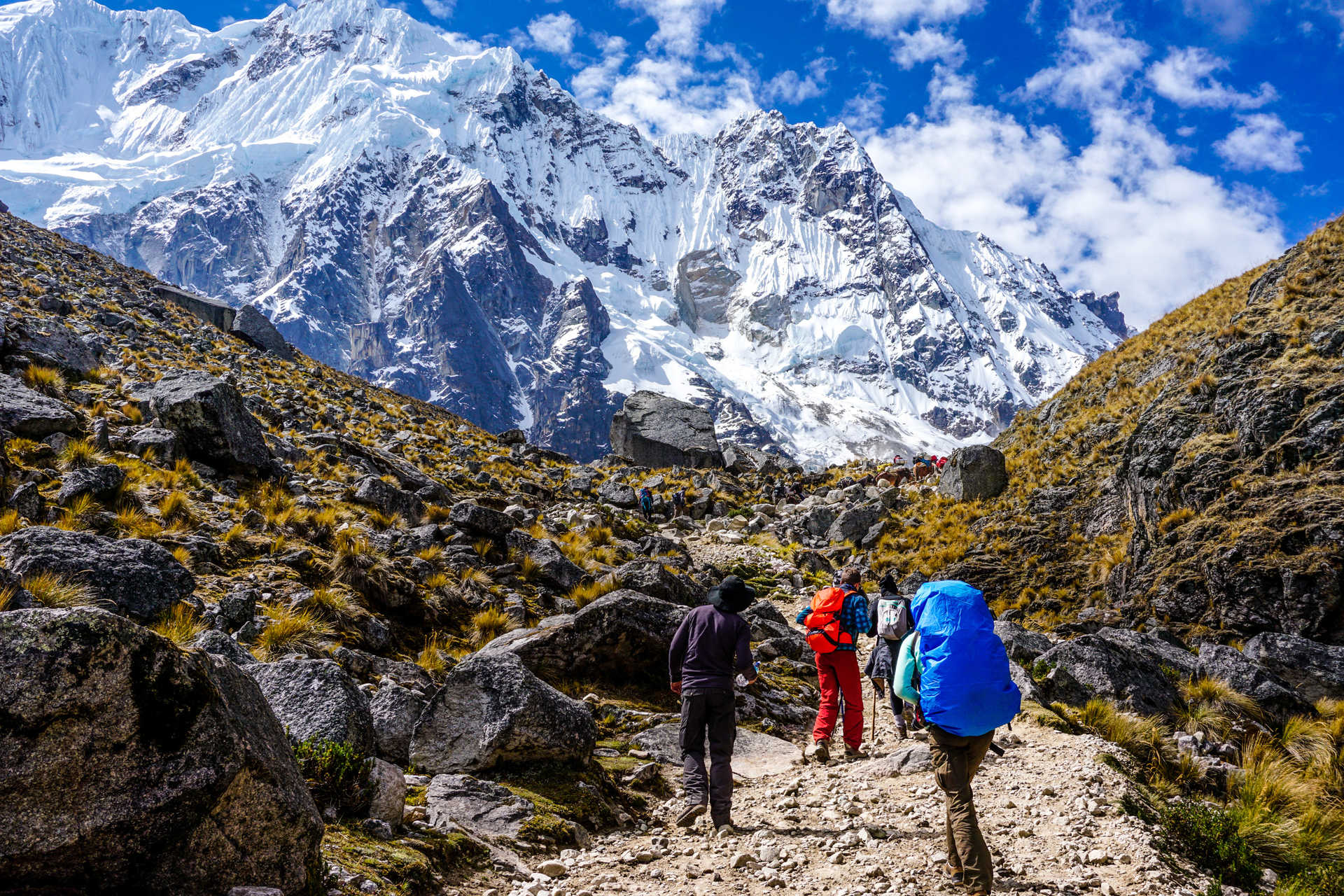
Salkantay itself means "wild mountain" in Quechua, and the peak rises to 6,271 metres — higher than anything on the classic Inca Trail, which never crosses above 4,215 metres. Walkers do not summit it. They pass beneath its south face on a saddle that has served as an Andean trading corridor for centuries, long before the route acquired a name in guidebooks. What a reader is really weighing when they compare a 5 day salkantay trek itinerary against shorter variants is the altitude curve. The route front-loads its difficulty: the pass arrives early, on the second walking day, when acclimatisation is least established. After that the profile falls steadily — through Wayracmachay, into the cloud forest around Colcapampa and Lucmabamba, past coffee plots and granadilla vines, before the trail meets the Hidroeléctrica rail line and the final walk toward Aguas Calientes. Terrain changes underfoot with the altitude: frost-hardened grass and loose moraine give way to mud, ferns and hummingbirds inside a single day. Temperature can swing more than twenty degrees between a Soraypampa dawn and a Santa Teresa afternoon. The practical consequence is that the route rewards patience at the start rather than speed. Most walkers who struggle do so between Soraypampa and the pass, not on the longer, flatter kilometres later. Guides watch for headache, appetite loss and broken sleep in the first camp, and a night spent at Cusco or in the Sacred Valley beforehand changes the odds considerably. The community entrance fee at Mollepata is collected on the ground and belongs to the campesino community whose land the trail crosses — a reminder that this is a working landscape, not a park. Humantay Lake, the turquoise glacial pool above Soraypampa, sits on most versions of the Salkantay route as an optional side climb; it is a useful acclimatisation gauge, since a walker who labours on that short ascent will find the pass harder still. Read the day-by-day breakdown alongside the practical sections on this site, and the shape of a five day salkantay trek to Machu Picchu becomes easy to plan around rather than guess at.
“The route front-loads its difficulty: the pass arrives early, when acclimatisation is least established.”
Detailed 5 Day Salkantay Trek Itinerary: Day-by-Day Route
This day-by-day plan suits trekkers with moderate fitness who are already acclimatised to Cusco's altitude, covering roughly 70 km over five days from Mollepata to Machu Picchu. Each day is anchored to a named camp or village on the standard route, with an early start window of 06:00–09:00 to reach camp before dusk.
Mollepata to Soraypampa
Register at the Mollepata control point, then walk or transfer to Challacancha and follow the Humantay canal path to Soraypampa camp at 3,900 m. Around 5–6 hours of walking; the optional side climb to Humantay Lake adds 2–3 hours.
Soraypampa to Chaullay
The longest day: a steady climb to the Salkantay Pass at 4,630 m, then a long descent through Huayracmachay into cloud forest at Chaullay. Allow 9–10 hours and start by 06:00, as the pass clouds over by late morning.
Chaullay to La Playa
Gentle downhill along the Santa Teresa river valley past Collpapampa and coffee smallholdings to La Playa Sahuayaco. Roughly 6 hours on a wide track, with the last stretch on a dirt road shared by vehicles.
La Playa to Aguas Calientes
Climb to the Llactapata ruins for the first sightline to Machu Picchu, descend to the Hidroeléctrica station, then walk the railway line to Aguas Calientes. About 7–8 hours in total; the railway section takes roughly 3 hours.
Machu Picchu citadel
Enter the citadel on your booked circuit, following the fixed one-way route past the Sun Temple and main plaza. Plan on 2–3 hours inside; entry is by timed slot, so allow queueing time at the gate.
Getting to the Salkantay Trail Start for Your 5 Day Salkantay Trek Itinerary
The Salkantay Trail is located in the Cusco Region of Peru. The standard approach involves traveling from Cusco to the town of Mollepata, which serves as the primary gateway for the trek.
Cusco to Mollepata (local bus or collective from Arcopata terminal)
Cusco to Mollepata (private transfer)
Mollepata to Salkantay Trailhead (official start)
Best Time to Start the 5 Day Salkantay Trek Itinerary
The dry season, specifically from May to September, offers the most stable conditions for the Salkantay Trek. During these months, clear skies and lower precipitation probabilities define the experience.
May to September
Low to moderateDry, clear skies, 5°C to 20°C
October to April
Moderate to highIncreased rain, frequent fog, 7°C to 18°C
Daily arrival window
N/A—
Adhere to the best arrival window of 06:00–09:00 to avoid mid-day heat and ensure arrival at campsites before dusk.
Verdict: The best time to start the trek is between May and September, beginning your daily segments between 06:00 and 09:00.
Essential Preparation for Your 5 Day Salkantay Trek Itinerary
The Salkantay route crosses a 4,600 m pass and ends at a controlled archaeological site, so several preparations have to be locked in weeks ahead rather than the night before.
-
Reserve your Machu Picchu entry early — Circuit slots for the final day sell out weeks ahead in peak months, and the pass is tied to a named date.
-
Carry your original passport — Entry to Machu Picchu and the return train both check the passport number printed on your booking, and photocopies are refused.
-
Buy travel insurance covering 4,600 m — Standard policies often cap trekking cover at 3,000 m, leaving the Salkantay Pass excluded.
-
Spend two nights acclimatising in Cusco — Arriving at 3,400 m and walking uphill the next morning is the most common cause of people turning back.
-
Bring 20 PEN in small notes — The community entrance fee for the Mollepata Peasant Community is 20 PEN per person and is collected in cash on the trail.
-
Break in your boots beforehand — The descent into the cloud forest is long and steep, and new boots reliably produce blisters by day three.
-
Pack layers for -2°C to 25°C — The trek passes from glacial camps to humid jungle, sometimes within a single day.
-
Withdraw cash before leaving Cusco — There are no ATMs on the trail, and hot springs, snacks and tips all need soles.
Check availability
Frequently asked questions about 5 day salkantay trek itinerary
Everything you need to know about 5 day salkantay trek itinerary